

Table of Contents
- Why Accurate Measurements Matter for Dog Clothing
- What You'll Need Before You Start Measuring
- How to Measure a Dog's Back Length
- How to Measure a Dog's Chest (Girth)
- How to Measure a Dog's Neck Circumference
- Using a Dog Clothing Size Chart to Choose a Size
- Dog Clothes Sizing for Small Breeds
- Dog Clothes for Wide-Chested Breeds
- Frequently Asked Questions
Last Updated: October 15, 2026
Why Accurate Measurements Matter for Dog Clothing
The core problem: dog clothes size labels aren't standardized. A medium from one maker can fit like a large from another. The only reliable path is measuring your dog and comparing those numbers to each brand's own chart.

The whole process takes about five minutes, and once your dog's numbers are written down, you can reuse them for every future purchase.
What You'll Need Before You Start Measuring
Gather your tools first so your dog doesn't have to stand still while you hunt for supplies:
- A soft tape measure (the flexible kind used for sewing)
- A pen and paper, or your phone's notes app
- A few small treats
- A flat, non-slip surface for your dog to stand on
A flexible tape curves around the body; a stiff builder's tape won't wrap the rib cage or neck properly.
No soft tape? Use string or a phone charging cable: wrap it around your dog, mark where the ends meet, then lay it flat against a ruler.
Treats matter more than people expect: a calm, standing dog gives accurate numbers, a wriggling one gives guesses.
How to Measure a Dog's Back Length
Back length is the number most sizing charts list first, and it's the easiest to get wrong.
Back length is the distance from the base of the neck to the base of the tail, measured along the spine while your dog stands.
Here's how to take it:
- Find the base of the neck, where the neck meets the shoulder blades.
- Find the base of the tail, where the tail meets the body.
- Lay the soft tape along the spine, following its natural curve, flat against the body.
- Write down the number in centimetres.
Don't measure down the side of the body or around the belly, that gives a longer number and a garment that drags on the ground.
Your dog must be standing, not sitting or lying down, sitting compresses the spine and shortens the measurement noticeably.
How to Measure a Dog's Chest (Girth)
Chest girth is the distance around the widest part of the rib cage, measured just behind the front legs.
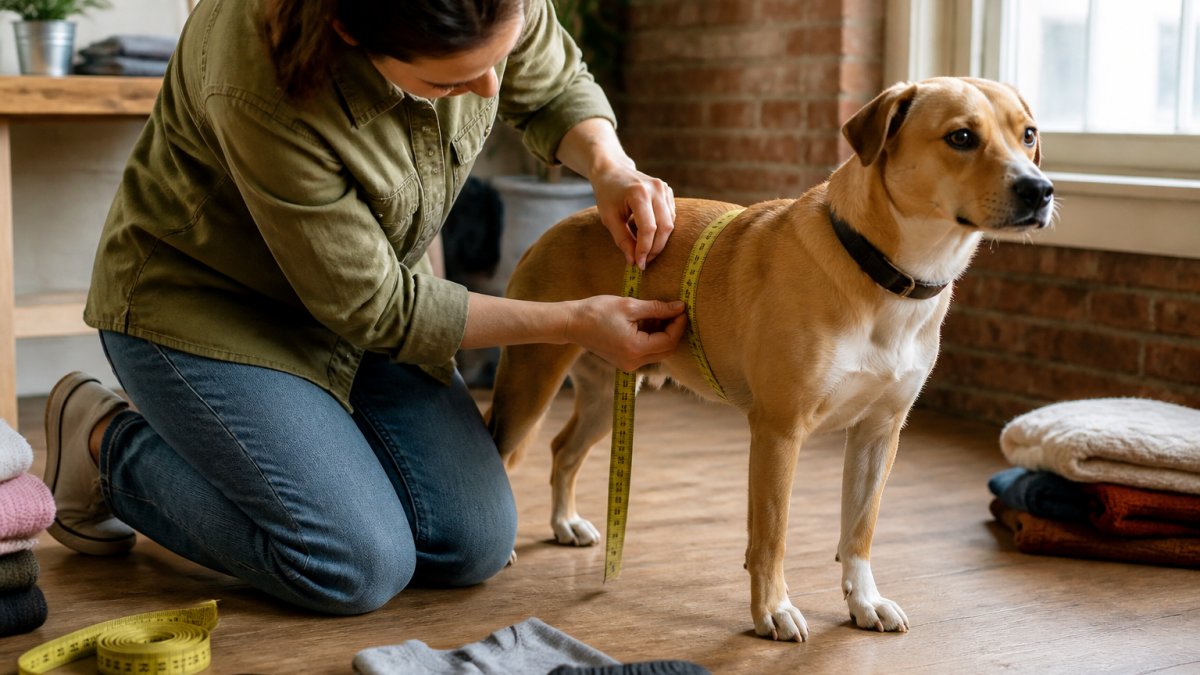
This measurement decides whether a garment fits at all. A coat can be slightly long or short and still work; a chest that's too tight causes real problems.
To measure chest girth:
- Have your dog stand on all four legs.
- Wrap the soft tape around the body, passing behind the front legs and up over the shoulder blades.
- Check that the tape sits at the widest point of the rib cage, not at the armpits.
- Snug the tape so it touches the fur but doesn't press into the skin, then record the number in centimetres.
Tape tension matters: pull tight and you'll order a garment that squeezes; let it sag and you'll order something loose that shifts during walks.
A useful check: you should be able to slide one finger under the tape. That's roughly the ease you want in the finished garment.
How to Measure a Dog's Neck Circumference
Neck circumference is the distance around the base of the neck, where a collar naturally sits.
This one is quick, but position matters. Measure too high, near the ears, and you'll get a number that's too small.
Steps:
- Locate where your dog's collar normally rests.
- Wrap the soft tape around the base of the neck at that point, keeping it level, not angled up toward the head.
- Add a small amount of slack so the tape isn't choking, then write down the number.
For thick necks or loose skin, measure twice and take the larger number, it's easier to adjust a roomy neckline than squeeze a tight one over the head.
If your dog is between sizes on the neck, size up: a slightly loose neckline can be adjusted with the closure, a tight one cannot.
Using a Dog Clothing Size Chart to Choose a Size
Every brand's dog clothing size chart is different, so never assume your dog is "a medium." Match your three numbers to the specific chart for the item you're buying.
Here's how to work through it:
- Lay your measurements next to the chart.
- Find the row where chest girth fits your dog's number.
- Check that back length and neck circumference also fall within that row's range.
- If your dog fits one measurement but not the others, or sits between sizes, size up.
| Measurement | Where to Measure | Common Sizing Mistake | What to Do Instead |
|---|---|---|---|
| Back length | Base of neck to base of tail, along the spine | Measuring down the side of the body | Follow the spine while the dog stands |
| Chest girth | Widest part of the rib cage, behind the front legs | Measuring at the armpits | Measure at the widest point, one finger of slack |
| Neck circumference | Base of the neck, at collar position | Measuring too high, near the ears | Measure where the collar sits |
Chest girth is the deciding number for most garments, if you only take one measurement, take that one.
Not All Garments Fit the Same Way
This is where most sizing guides stop, and where most returns start. A size chart isn't a universal key; it's specific to the garment type.
Coats and jackets are cut with the most ease, since they layer over a dog's coat or a thin base layer.
Pet clothing, dog clothes, supplies →
Sweaters and knitwear stretch, so their charts run closer to the body and a snug sweater often relaxes with wear.
Costumes and novelty outfits are the least standardized, often cut for appearance rather than movement with narrow leg openings and stiff fabrics.
Harness-compatible clothing adds a fourth variable: the harness.
Sizing Systems Vary More Than You'd Expect
Some brands size by weight, others by breed, and others by measurements. Weight and breed are rough guides at best. A fit based on actual measurements beats both every time.
Brands targeting small breeds lean on weight ranges, while performance or outdoor gear brands lean on measurements. Neither is wrong, but they're not interchangeable.

When a chart gives you both, always trust the measurement. Weight doesn't tell you where the mass sits, a deep-chested dog and a stocky dog can weigh the same and need completely different sizes.
Dog Clothes Sizing for Small Breeds
Small breeds need different attention than large ones. Their bodies are shorter, so a garment cut for a medium dog will swallow them.
For small breeds, focus on back length first. A coat that's too long trips them up on stairs and collects mud. Chest girth still matters, but length is what makes a small dog look swamped.
A few practical points for small breeds:
- Measure more often. Small dogs can change shape quickly with weight shifts.
- Keep the tape snug but never tight. Small rib cages are more sensitive to pressure.
- Check the leg openings. Short legs need openings placed higher, or the fabric drags.
- Look for adjustable closures at the neck and chest.
Puppies: Measure Before Every Purchase
A puppy will outgrow a garment within weeks, so measure right before you buy and expect to re-measure often. Don't stock up on multiple sizes at once.
Puppies don't grow evenly: chest girth can expand faster than back length during a growth spurt, so a garment that fit last month may now be tight at the chest while still loose at the back.
A practical cadence: measure your puppy every two to three weeks until they're near adult size, and re-check the chest girth before every purchase.
Body Shape Matters as Much as Size
"Small breed" isn't one shape. A Dachshund and a Chihuahua are both small, but their proportions are opposite, one long-backed and short-legged, the other compact and fine-boned.
For long-backed small breeds like Dachshunds, back length fails first. A garment sized to the chest will often be too short in the back, riding up over the hips.
For fine-boned small breeds like Chihuahuas and Italian Greyhounds, the chest girth is usually the deciding number, but the neck can be surprisingly narrow.
Dog Clothes for Wide-Chested Breeds
Wide-chested breeds are the hardest to fit, and standard sizing charts rarely work for them.
French Bulldogs, Pugs, and similar builds have a chest that's broad and deep relative to their back length.
We design for all sizes, including wide-chested dogs, so the chest has room without the rest of the garment ballooning.
When you measure a wide-chested dog:
- Take the chest girth at the widest point, which sits further forward than on other breeds.
- Measure the neck at the base, since these breeds often carry thickness there too.
- Measure back length, but expect it to be short relative to the chest.
- Compare all three against the chart, prioritize chest girth, then check the fit by watching your dog walk, sit, and turn.
That last step matters. A garment can measure correctly and still restrict movement. Watch your dog move in it before you commit to the size.
If your dog has an unusual build that doesn't match any chart row, contact the seller with your numbers.
Wide-chested breeds like French Bulldogs and Pugs, where the chest measurement runs large relative to back length and standard charts don't fit.
Frequently Asked Questions
What size does a 7 lb dog wear?
A 7 lb dog typically falls into the XS or S range, but weight alone is not enough to choose a size. You need to measure back length, chest girth, and neck circumference. For example, a 7 lb Dachshund might need a different size than a 7 lb Chihuahua because of body shape. Always compare your dog's measurements to the specific dog clothing size chart for the brand you are buying from.
How do you measure a dog's chest for clothes?
Wrap a soft tape measure around the widest part of your dog's chest, which is just behind the front legs. Keep the tape snug but not tight, and make sure it sits flat against the fur. Record the measurement in centimetres. If your dog has a thick coat, add 2-3 cm of ease so the clothing does not pull. This chest girth measurement is the most important number for finding a comfortable fit.
Should dog clothes fit tightly or loosely?
Dog clothes should fit snugly enough to stay in place but loose enough for your dog to move, breathe, and sit comfortably. You should be able to slide two fingers under the fabric at the neck and chest. If the clothing restricts movement or bunches up, it is too tight or too loose. For wide-chested breeds, look for pieces designed with extra room across the chest and a shorter back length.
What should I do if my dog's measurements fall between sizes?
If your dog measures between two sizes, size up for comfort and room to move. A slightly larger piece can be adjusted with the closures, but a too-small piece will restrict movement and cause discomfort. Check the brand's sizing chart for guidance on ease. For puppies, always size up because they grow quickly. If you are unsure, contact the brand's customer service with your dog's measurements for a recommendation.
Finding clothes that fit a wide-chested or hard-to-size dog can feel like guesswork. It doesn't have to be. DUD'S PET CLOTHING designs designer-inspired, streetwear-style pieces with smart, comfortable fits for all sizes, including wide-chested breeds, so your dog gets room to move without the garment hanging loose everywhere else. Our hand-picked collection keeps dogs cozy in real weather and looks sharp on daily walks. Add to cart and get a fit that works the first time.